

The choice of tool material has a great impact on tool life, processing efficiency, processing quality and processing cost. When cutting tools, they must withstand high pressure, high temperature, friction, shock and vibration. Therefore, the tool material should have some basic skills. Here we take the OPT cutting tools as an example.
1. Features of OPT cutting tools:
① Extremely high hardness and wear resistance:
Natural diamond is the hardest substance that has been found in nature. Diamond has extremely high abrasion resistance. When machining high-hardness materials, the life of diamond tools is 10 to 100 times or even hundreds of times that of hard alloy tools.
② Has a very low coefficient of friction:
the friction coefficient between diamond and some non-ferrous metals is lower than other tools, the coefficient of friction is low, the deformation during processing is small, and the cutting force can be reduced.
③The cutting edge is very sharp:
The cutting edge of the diamond tool can be ground very sharply. The natural single crystal diamond tool can be as high as 0.002 ~ 0.008μm, which can perform ultra-thin cutting and ultra-precision machining.
④ Has high thermal conductivity:
PCD cutting tools has a high thermal conductivity and thermal diffusivity, cutting heat is easily dissipated, and the temperature of the cutting part of the tool is low.
⑤ Has a lower thermal expansion coefficient:
The thermal expansion coefficient of diamond is several times smaller than that of cemented carbide, and the change in tool size caused by cutting heat is small, which is particularly important for precision and ultra-precision machining that requires high dimensional accuracy.
2. Application of PCD cutting tools.
OPT cutting tools are mostly used for fine cutting and boring of non-ferrous and non-metal materials at high speeds. Suitable for processing various wear-resistant non-metals, such as FRP powder metallurgy blanks, ceramic materials, etc .; various wear-resistant non-ferrous metals, such as various silicon aluminum alloys; various non-ferrous metals finishing.
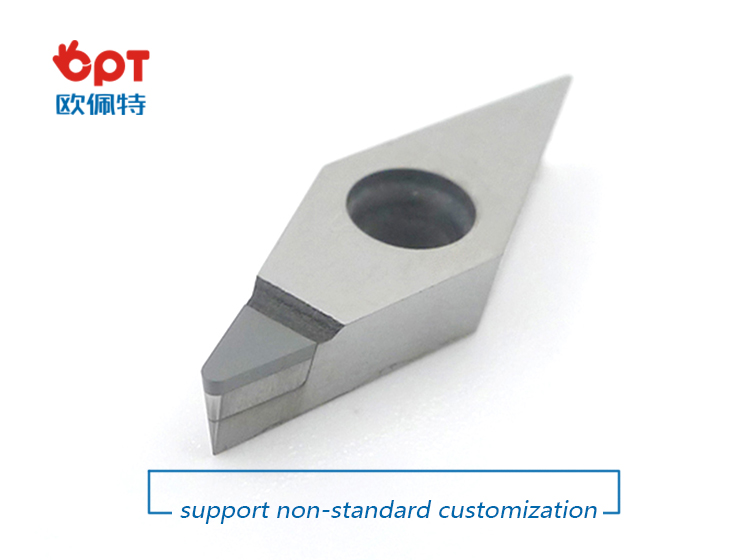
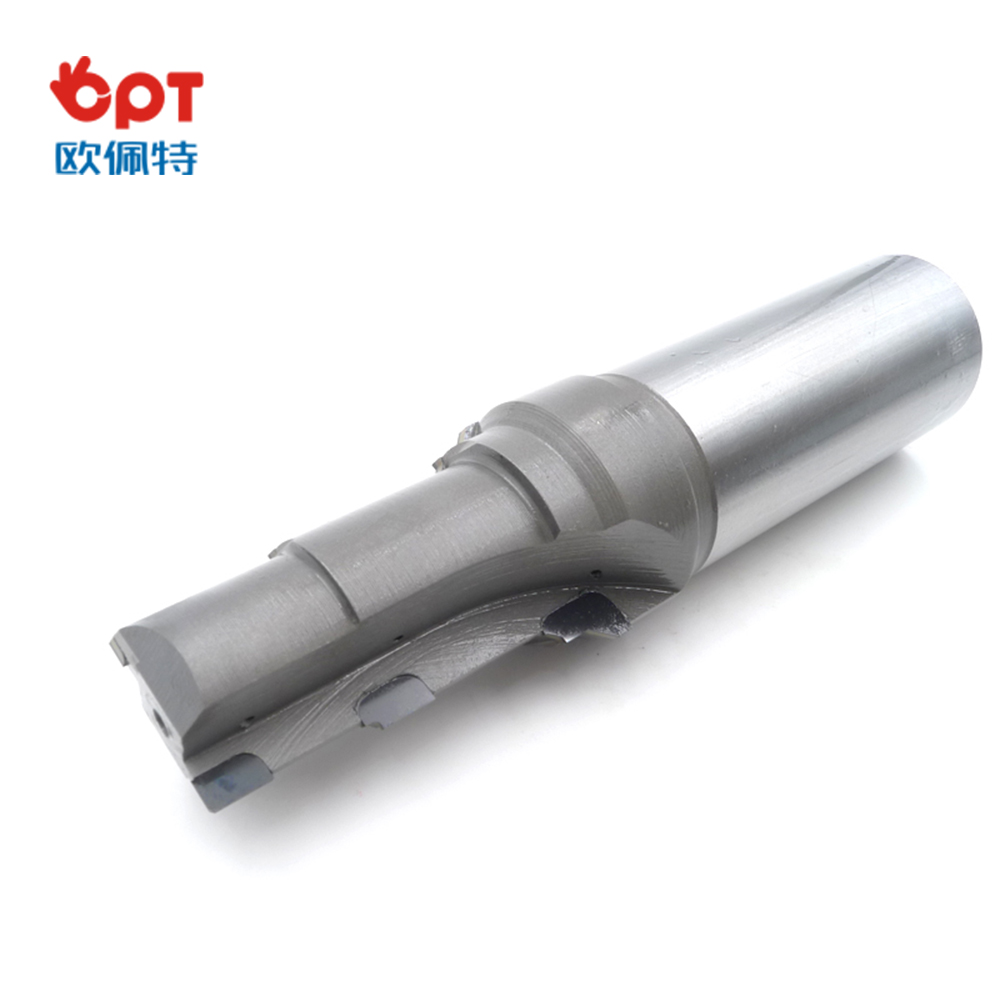
The disadvantage of diamond tools is that they have poor thermal stability. When the cutting temperature exceeds 700 ° C to 800 ° C, their hardness is completely lost. In addition, it is not suitable for cutting ferrous metals because diamond (carbon) is easy to interact with iron at high temperatures. The action of atoms converts carbon atoms into a graphite structure, and the tool is easily damaged.
